Thinking about buying an acreage near Suffield? It can be a great way to get more space, more privacy, and more flexibility, but rural properties also come with details that are easy to miss if you are used to town living. If you want to buy with fewer surprises, it helps to understand how servicing, access, zoning, and permits work in this part of Cypress County. Let’s dive in.
Why location near Suffield matters
When people say an acreage is "near Suffield," that can mean a few different things. Suffield is a hamlet in Cypress County, roughly 30 km northwest of Medicine Hat, near Highway 884, the Trans-Canada Highway, and the Canadian Pacific Railway main line. The area also sees military traffic moving through the hamlet and across the highway toward CFB Suffield.
That local context can shape your day-to-day experience more than you might expect. Road noise, rail activity, and traffic patterns may affect how a property feels for everyday living, hobby use, or long-term resale. A property that looks ideal on paper may work very differently once you factor in access and surroundings.
Start with the land use designation
Before you fall in love with a parcel, confirm how Cypress County designates the land. Agriculture is the county’s primary land use, while acreages are often handled through agricultural or country residential designations. You should not assume a property’s use based only on lot size or appearance.
This matters because your plans for the property need to fit the current designation. If you want to build, add structures, or change how the land is used, the county may require approvals first. In some cases, a land-use reclassification may be needed before a development permit application can even move forward.
Why current use does not tell the full story
Cypress County notes that land-use amendments happen regularly, sometimes for small areas or even individual lots. That means nearby parcels may not stay exactly as they are today. If future surrounding uses matter to you, ask questions early and review the property’s designation carefully.
For buyers, this is about more than rules. It is also about protecting your lifestyle and your resale position. The easier it is to understand how the parcel fits within county planning, the more confident you can feel about your purchase.
Understand whether the property is in or outside the hamlet
One of the biggest practical differences for a Suffield-area acreage is whether the property is inside the hamlet or outside it. That single detail affects water, sewer, garbage service, and your overall ownership responsibilities. It is one of the first things you should confirm before making an offer.
Within hamlet-serviced areas, county utility systems may be available. Cypress County lists Suffield with EPCOR for electricity and Apex Utilities or Forty Mile Gas for natural gas, and the county says sanitary sewer systems operate in all hamlets except Dunmore and Walsh. The county also notes that only the owner shown on title can open a utility account, and billing is every two months.
Outside hamlets, the setup is usually more independent. Cypress County says rural residents and businesses outside hamlets provide their own water through groundwater wells, trucked-in cistern fills, or rural water co-ops. The county also notes that water co-ops are not owned or operated by the county.
Questions to ask about water
Water is one of the most important acreage questions because it affects both livability and financing discussions. You will want to know exactly where the water comes from, who maintains the system, and what your ongoing responsibilities will be.
Ask questions like:
- Is the property served by a well, a cistern, a rural water co-op, or county service?
- If there is a well, who has maintained it?
- If there is a cistern, how is it filled and how often?
- If there is a co-op connection, who operates it and what are the costs and rules?
Cypress County also says its water supply is managed through a drought plan with staged conservation measures. If you plan to do a lot of yard watering, keep animals, or use significant water outdoors, that is worth understanding up front.
Questions to ask about sewer and septic
Sewer is another major split between hamlet and rural living. A property inside a serviced area may connect to county systems, while an acreage outside the hamlet may rely on a private sewage system.
If the property has a private system, Alberta rules still apply. The province says private sewage systems under 25 cubic metres per day are governed by the 2021 Alberta Private Sewage Systems Standard of Practice, and permits are required before installation, alteration, or additions. You will want to confirm the type of system, whether permits were obtained, and whether there have been any changes over time.
Road access can make or break an acreage
A beautiful property is much less practical if access is difficult or uncertain. Cypress County maintains more than 2,000 km of roads, with most surfaces being gravel. In rural areas, the county uses a township-road and range-road addressing system, which is useful to understand when you are reviewing directions, service access, and legal descriptions.
Not every road situation is the same. The county says dead-end roads to residences may be maintained, undeveloped road allowances may remain as bladed access or be gravelled with cost sharing, and road construction to new residences in agricultural areas may be cost-shared. Road bans and oversize-load permits can also apply.
Why access matters beyond convenience
Legal and physical access affect more than your daily drive. They can influence moving plans, construction logistics, lender questions, and future resale appeal. If you hope to bring in building materials, equipment, or large deliveries, road restrictions can become very relevant.
This is why access should be verified early, not treated as a minor detail. A clear understanding of the road that serves the parcel can help you avoid expensive surprises later.
Permits and outbuildings deserve a close look
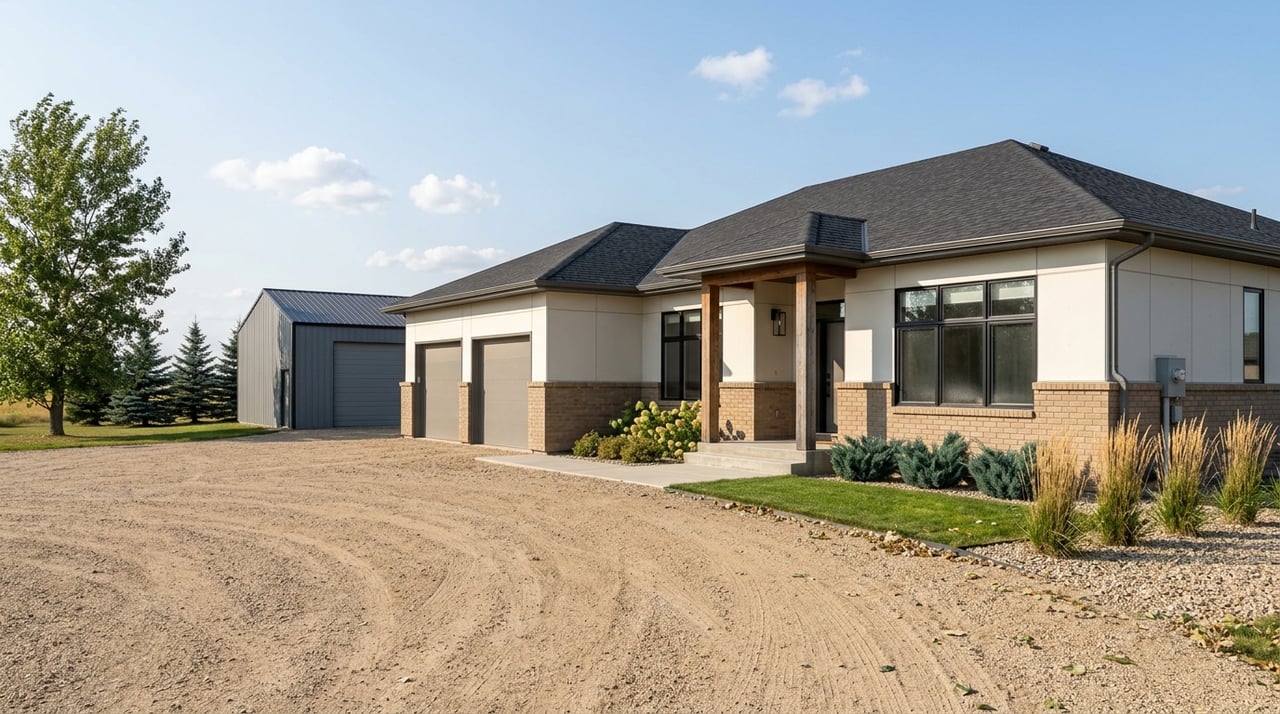
Acreage buyers are often drawn to shops, sheds, shelters, and other outbuildings. Those features can add a lot of value and usefulness, but you should still confirm what was permitted and whether setbacks were respected.
Cypress County says development permits are required for new construction, additions, decks, patios, accessory buildings such as sheds or storage containers, and changes in use. The county also says some rural and farm items may not require a development permit if setback rules are met, including haystacks, portable granaries, permanent farm buildings under 46.45 m², shelterbelts, dugouts, reservoirs, wells, sewage disposal fields, and certain livestock shelters and garden sheds.
Do not stop at county development rules
There is another layer to check. Cypress County says it does not enforce provincial building codes, so separate permits under Alberta’s Safety Codes Act may still be needed through accredited inspection agencies.
That means a structure can involve more than one approval path. If there is a shop, garage addition, private sewage work, gas installation, plumbing work, or electrical work on the property, ask for records where available. Clear documentation can make your purchase smoother now and easier to support at resale.
Financing and appraisal may be more detailed for acreages
Buying an acreage often involves more lender questions than buying a standard in-town home. CMHC says mortgage professionals may ask for details such as water source, sewage type, lot size, garage type, and planned improvements. That is especially relevant for rural properties with wells, septic systems, outbuildings, or unfinished site work.
CMHC also says mortgage loan insurance is usually required when the down payment is under 20% of the purchase price or lending value. It notes that the minimum down payment is generally 5% up to $500,000 and 10% on the portion above that. For buyers, this is a reminder that acreage financing can depend on both the property itself and how a lender views its overall risk and marketability.
Survey and appraisal details to check
CMHC says a survey or certificate of location may be needed if the seller does not have one, or if it is more than five years old. On acreages, that can be particularly important if there are multiple structures, approaches, or questions about easements and boundaries.
Appraisals also rely on physical and functional characteristics, comparable sales, and market conditions. In practical terms, documented servicing, legal access, and permitted improvements can make a big difference. The cleaner the property file, the easier it may be for the value to make sense to a lender and to a future buyer.
Think about resale before you buy
Even if this feels like your long-term property, resale still matters. Cypress County says residential properties are assessed at market value using recent comparable sales, while farmland and certain non-residential properties use regulated rates derived from provincial legislation. The county issues assessments annually and provides a 67-day complaint period.
What matters most for resale is not just the number of acres. Buyers and appraisers tend to look closely at how easy the property is to understand and use. Reliable servicing, clear access, and documented improvements often help a rural property feel more straightforward and more marketable.
A smart pre-offer checklist
Before you write an offer on an acreage near Suffield, try to answer the practical questions first. A little extra due diligence now can save a lot of stress later.
Use this checklist as a starting point:
- Is the parcel inside hamlet servicing or outside it?
- What is the exact water source?
- Who maintains the water system?
- Is the sewer connection municipal or private?
- If the system is private, were the proper permits obtained?
- What road provides legal access?
- Are there any road ban, load, or maintenance issues?
- Are existing outbuildings permitted where required and setback-compliant?
- Is there a current survey or clear evidence of easements and approaches?
Local guidance can simplify the process
Acreage purchases usually involve more moving parts than a standard residential sale. That does not mean they are harder to buy. It simply means the right questions need to be asked in the right order.
If you are considering buying an acreage near Suffield, a practical local approach can help you compare properties clearly and avoid costly assumptions. When you want straightforward advice on rural and acreage opportunities around Medicine Hat and Cypress County, connect with Bob Ruzicka.
FAQs
What should you check first when buying an acreage near Suffield?
- Start by confirming the land-use designation, whether the property is inside or outside hamlet servicing, and how water, sewer, and road access are handled.
How does water service work for acreages near Suffield?
- Outside hamlets, Cypress County says properties typically rely on groundwater wells, trucked-in cistern fills, or rural water co-ops, while some properties in serviced hamlet areas may have county utility connections.
Do you need permits for buildings on a Suffield-area acreage?
- Cypress County says many projects require development permits, including new construction, additions, decks, patios, accessory buildings, and changes in use, while some rural items may be exempt if setback rules are met.
Why does road access matter for a rural property near Suffield?
- Road access affects daily travel, deliveries, construction planning, legal access, and resale appeal, and Cypress County notes that maintenance, cost sharing, road bans, and oversize-load rules can all come into play.
What financing details matter when buying an acreage in Cypress County?
- Lenders may ask for details about water source, sewage type, lot size, garage type, and planned improvements, so it helps to gather clear property information early in the buying process.